In this article
Cost To Build Plan 430 99 From Houseplans.Com (2026)
Houseplans.com Plan 430-99 is marketed as “economical to build,” but in 2026 the real cost to build it can still swing by well over $150,000+ depending on where you build, what you build on, and what you build it with.
Before anyone throws out a single number, it helps to start with what we actually know about the plan—then layer in the cost drivers that cause wide spreads in bids.
Quick overview: what Plan 430-99 includes (and what it doesn’t)
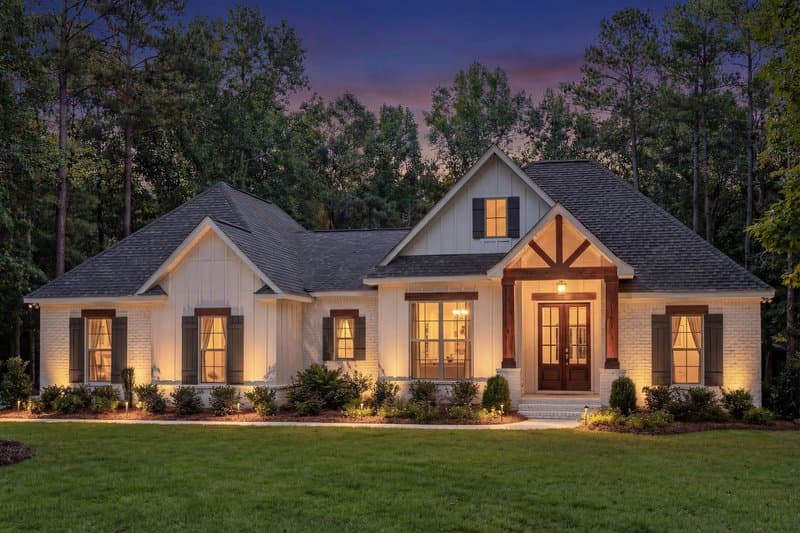
Plan 430-99 is a 1-story, 3-bedroom, 2-bath Craftsman/Country home with a 2-car side-entry garage.
Key specs published on Houseplans.com include: 1,769 sq ft conditioned space, 525 sq ft garage, covered front porch (46 sq ft), and covered rear porch (122 sq ft), with a 9' main ceiling and stick-framed roof with shingle roofing. Exterior wall framing is listed as 2x4, with exterior finishes shown as brick/siding. Depth is 49' 8" and width is 62' 6". Houseplans also notes that choosing a basement option increases the depth to 54'. (Source: Houseplans.com Plan 430-99 specs)
Those details matter because cost isn’t just price per square foot of conditioned space. This plan carries cost in places people routinely forget to budget for:
- A 525 sq ft garage (significant slab, framing, doors, and electrical)
- Covered porches (roofing + structure + concrete/footings)
- A roof with multiple pitches (labor + waste factors)
- Optional foundation types (slab vs crawl vs basement costs differ dramatically)
2026 “starting point” costs: why national averages mislead
For 2026, many homeowners begin with a national cost-per-square-foot range. That’s useful for orientation, but it’s not a quote—and it doesn’t tell you what’s missing (site work, upgrades, permitting, utilities, and local code items).
A recent 2026 state-by-state analysis reports an average U.S. construction cost around $162/sq ft, with examples ranging from $154/sq ft in Mississippi up to $230/sq ft in Hawaii—a huge spread driven by labor markets, material logistics, and regulation. (Source: TXR AC “Average Home Construction Cost: 2026 State-by-State Analysis,” published March 10, 2026)
That’s already a 49% swing before we factor in:
- Sloping vs flat site
- Basement vs slab
- Coastal wind requirements or seismic engineering
- Finish level (economy vs standard vs above-average)
- Bid timing and local contractor backlog
What it might cost to build Plan 430-99 in 2026 (estimated ranges)
Below are rough 2026 ballpark estimates to illustrate variability—not a substitute for a line-item estimate.
1) Base “build cost” range (conditioned space only)
If we apply broad 2026 cost-per-square-foot ranges to 1,769 sq ft:
- Lower-cost markets (roughly $155–$175/sq ft):
$274,000 – $310,000 (conditioned space only) - Mid-range markets (roughly $175–$205/sq ft):
$310,000 – $363,000 - Higher-cost markets (roughly $205–$230/sq ft):
$363,000 – $407,000
These numbers are incomplete because they exclude major line items that are very real for Plan 430-99—especially the garage, porches, site work, and local soft costs.
2) Add garage + porches (often overlooked in “$/sf” math)
Plan 430-99 includes:
- Garage: 525 sq ft
- Covered porches: 46 + 122 = 168 sq ft
Garages and porches usually cost less per sq ft than finished living area, but they’re not “free.” Depending on region and specs (doors, finishes, slab thickness, roof tie-ins), it’s common for these spaces to add tens of thousands.
A realistic 2026 planning allowance might look like:
- 2-car garage (525 sq ft): ~$35,000–$75,000+
- Covered porches (168 sq ft total): ~$10,000–$30,000+
That means two households building “the same” 1,769 sq ft plan can differ by $45,000–$105,000+ simply based on how their garage/porch structure, roofing complexity, concrete, and exterior finishes are specified and priced locally.
City-level variation examples (why ZIP code matters)
State averages are helpful, but construction pricing is often metro-driven. Labor availability, inspection timelines, union presence, and subcontractor competition can vary dramatically across cities in the same state.
Here are practical examples of how Plan 430-99 pricing can diverge:
Austin vs. rural Texas
Texas averages may look moderate (the 2026 analysis lists ~$162/sq ft for Texas), but a hot metro with tight labor can price meaningfully higher than a rural county—especially for trades like concrete, HVAC, electrical, and framing.
Seattle metro vs. eastern Washington
Washington is listed around $193/sq ft in that same 2026 analysis, but Seattle-area bids can run higher than smaller markets because of demand, logistics, and sometimes stricter local energy/permit requirements.
Florida coastal counties vs. inland
Florida’s state number in the 2026 analysis appears around $160/sq ft, but coastal wind-borne debris zones and hurricane requirements can add cost through:
- stronger roof-to-wall connections
- impact-rated glazing or shutters
- more robust fastening schedules and inspection requirements
Bottom line: Plan cost is not a state number—it’s a ZIP code + site + spec package number.
The biggest cost drivers for Plan 430-99 specifically
Plan 430-99 is “economical” in the sense that it’s a compact, 1-story layout—but several plan features can push costs up or down depending on choices.
Foundation choice: slab vs. crawlspace vs. basement
Houseplans.com shows foundation options available (slab, crawlspace, basement) and notes that basement can change the overall footprint depth. (Source: Houseplans.com Plan 430-99 page)
In cost terms:
- Slab-on-grade: often the most cost-effective on a flat, stable site
- Crawlspace: can be a smart choice on semi-sloped lots or where plumbing access matters
- Basement (unfinished or finished): potentially the largest swing item
Even without finishing the basement, excavation, waterproofing, drainage, egress requirements, and additional structural considerations can add a major premium compared with slab.
Exterior finish package: brick/siding is a wide range, not a single price
The plan lists brick/siding. That could mean:
- a small brick accent on the front elevation, fiber-cement lap siding elsewhere, and builder-grade trim
or - a heavier brick package, upgraded masonry details, higher-end siding, and more complex trim profiles
Material and labor pricing vary wildly here, and it’s one reason two bids for the “same” plan can come in far apart.
Roof complexity and framing
The roof is listed as stick-framed with a primary pitch of 12:12 and secondary pitch 9:12, asphalt shingles. Steeper pitches typically increase:
- labor time and safety setup
- waste factor on shingles and underlayment
- complexity around valleys/rakes/eaves
Energy code and mechanical system choices
A 1,769 sq ft home can still jump in cost depending on:
- heat pump vs. gas furnace
- ducted vs. ductless zoning
- ERV/HRV requirements in tighter envelopes
- insulation and air-sealing targets tied to local code
Energy requirements also vary by jurisdiction—and can be stricter in certain metro areas than statewide norms.
Soft costs that can rival a big upgrade package
Many homeowners focus on lumber and labor, but in 2026, soft costs can be shockingly material:
- Plan review / engineering (especially in wind, seismic, or snow-load zones)
- Permit fees and municipal impact fees (highly local)
- Surveys, soils reports, septic design (if not on sewer)
- Builder overhead and profit (varies by delivery method and market)
- Construction loan costs and interest carry (schedule matters)
The Houseplans.com page itself notes that local jurisdictions may require additional documents and that some regions require local engineering review and stamps (especially areas with stricter engineering requirements). (Source: Houseplans.com Plan 430-99 “Important Information” section)
A realistic 2026 budgeting framework for Plan 430-99 (how pros think)
Instead of asking “What’s the cost per square foot?” a better budgeting approach is:
- Start with a baseline build cost appropriate for your ZIP code and quality level (economy/standard/above-average).
- Add plan-specific structures (garage, porches, roof complexity, exterior finish intent).
- Price the foundation based on your site (soil, slope, groundwater, frost depth).
- Add site work and utilities (driveway length, clearing, well/septic, trenching, power).
- Add soft costs and contingencies (permits, engineering, loan, builder insurance, contingency).
That approach doesn’t give you a “quick answer,” but it does prevent the most common budgeting mistake: underestimating everything that isn’t drywall and flooring.
Key Takeaway: why the “cost to build Plan 430-99” is a range, not a number
Plan 430-99 is a great-sized, functional 1-story design—yet in 2026 the build cost can vary dramatically because:
- Location changes labor rates, material logistics, and code requirements (the 2026 state averages alone span roughly $154–$230 per sq ft).
- Foundation choice (slab vs crawl vs basement) can swing costs by tens of thousands.
- Garage + porches add meaningful dollars that aren’t captured in conditioned sq ft math.
- Finish level (cabinets, flooring, windows, siding/brick scope) can change the total more than most people expect.
- Soft costs (permits, engineering, impact fees, loan carry) are highly local and often underestimated.
If you want to build with confidence, you need a line-item estimate tied to your plan and your location, not a generic average.
Next step: see a real line-item report (free), then price your Plan 430-99
If you’re serious about building Plan 430-99 (or comparing it to similar plans), the fastest way to understand the real budget is to look at a line-by-line cost breakdown.
- Start by exploring a free interactive example so you can see exactly what a report includes: Try a free demo report
When you’re ready, you can price your home the right way—based on your plan and your build location:
- order your custom Cost To Build report for $32.95
Cost-to-build estimates aren’t new to us—costtobuildahouse.com has been providing detailed cost-to-build reports for nearly 20 years—and the whole point is to replace guesswork with a practical, decision-ready budget you can take to a builder.