In this article
Free instant estimate · ~30 seconds
Quick Estimator
No sign-upRough planning range based on your inputs and current regional cost indices — not a quote. Your plan, lot, and selections move the number; the full report prices all 60+ items to your exact zip.
✓ Free — no sign-up · ✓ 60+ line items · ✓ ZIP-localized · ✓ Planning figures, not bids
Cost To Build A House In West Virginia (2026)
If you’re trying to price a new home build in West Virginia, you’ll quickly discover that there isn’t one “average” that’s safe to budget from. Two homes with the same square footage can land tens (or hundreds) of thousands of dollars apart once you account for site conditions, foundation choice, finish level, labor availability, and local fees.
This guide uses current 2026 data points (with sources) to show how wide the cost spread really is—and why a line-item estimate for your plan in your zip code is the only way to budget with confidence.
The 2026 starting point: cost per square foot in West Virginia (and why it’s not enough)
A useful way to get oriented is cost per square foot for “standard finish” construction, then immediately zoom in by city and by finish level.
Based on 2026 RSMeans construction data published in March 2026 (city indexes applied), here are example “standard finish” benchmarks for a ~2,000 sq ft new build (structure only—site work and land can be separate depending on the situation):
- Charleston, WV (2026): about $125/sq ft standard finish; $182k–$267k cost range for a typical 2,000 sq ft home (RSMeans-based city index 1.08x vs state baseline). Source: CostToBuildHouse city guide (Updated March 2026; based on 2026 RSMeans).
- Morgantown, WV (2026): about $122/sq ft standard finish; $177k–$260k range; city index 1.05x. Source: CostToBuildHouse city guide (Updated March 2026; based on 2026 RSMeans).
- Parkersburg, WV (2026): about $113/sq ft standard finish; $163k–$240k range; city index 0.97x. Source: CostToBuildHouse city guide (Updated March 2026; based on 2026 RSMeans).
Even inside one state, this already shows a meaningful swing. And it’s before we talk about:
- basements vs slabs
- mountain lots, steep driveways, and retaining walls
- septic/well vs public utilities
- high-end kitchens/baths vs builder-grade
- schedule delays and subcontractor availability
A “real world” way to interpret these numbers
Think of $/sq ft as a starting coordinate, not a quote.
For example, a 2,000 sq ft plan at a “standard finish” benchmark might look like this:
- Parkersburg-area baseline: 2,000 × $113 ≈ $226,000
- Charleston-area baseline: 2,000 × $125 ≈ $250,000
But a single decision—like adding a basement, upgrading the exterior, or building on a steep lot—can wipe out that difference (and then some).
City and region differences inside West Virginia (Charleston vs Morgantown vs Parkersburg)
West Virginia construction pricing is heavily influenced by local labor pools, contractor backlogs, materials logistics, and inspection/permitting processes. RSMeans captures part of that through city indexes that adjust a baseline cost up or down.
Here’s what the 2026 RSMeans-based city guides above imply:
| Area (examples) | 2026 “Standard finish” estimate (approx.) | What that suggests |
|---|---|---|
| Parkersburg | ~$113/sq ft | Often lower-than-state-baseline conditions and pricing |
| Morgantown | ~$122/sq ft | Slightly higher, often influenced by local demand and contractor availability |
| Charleston | ~$125/sq ft | Higher index; can reflect labor demand, local fees, and logistics |
Why it matters: If you use one statewide average (or a national average), you can be off by 5–15% quickly—and that’s before plan-specific complexity.
Wondering what these ranges mean for your town? The free calculator above localizes them to your ZIP.
Get my West Virginia estimate ↑Finish level is one of the biggest multipliers (basic vs standard vs premium)
Most homeowners don’t realize how much the “finish level” label hides. In the 2026 data above, finish tiers for a 2,000 sq ft home commonly land in ranges like:
- Parkersburg example: Basic ~$96/sq ft, Standard ~$113/sq ft, Premium ~$153/sq ft (RSMeans-based city guide)
- Charleston example: Basic ~$106/sq ft, Standard ~$125/sq ft, Premium ~$169/sq ft (RSMeans-based city guide)
- Morgantown example: Basic ~$104/sq ft, Standard ~$122/sq ft, Premium ~$165/sq ft (RSMeans-based city guide)
That difference is not “a little nicer carpet.” It can include:
- cabinet grade (stock vs semi-custom vs custom) and layout complexity
- countertop material (laminate vs quartz vs natural stone)
- tile quantity/complexity (showers, surrounds, floors)
- window performance and size count (and black-frame premiums)
- exterior details (stone veneer, porch columns, mixed materials)
- trim packages (simple casing vs built-up profiles)
- lighting packages and electrical complexity
- appliance packages, plumbing fixtures, and shower systems
Budget reality: A “premium” finish level can easily add $60–$100+/sq ft compared to builder-grade in real projects once design and scope are fully specified.
Labor costs: the hidden driver behind your bids
Materials make headlines, but labor is often what separates one county’s pricing from another—and it’s also what makes two bids for the same plan come in far apart.
One way to see local differences is wage data. CareerOneStop (U.S. Department of Labor-sponsored) shows 2024 wage data for construction laborers in West Virginia, including metro-area variation:
- West Virginia (Construction Laborers) median: $18.64/hour (2024)
- Charleston, WV Metro median: $20.75/hour (2024)
- Parkersburg-Vienna, WV Metro median: $19.50/hour (2024)
- Huntington-Ashland, WV-KY-OH Metro median: $20.49/hour (2024)
Source: CareerOneStop “Wages for Construction Laborers in West Virginia” table (shows state and metro breakdowns).
These are laborer wages (not the fully burdened rate a contractor pays once you include payroll taxes, insurance, supervision, and overhead), and not the specialized trades (electrical, plumbing, HVAC) that can be higher. But they still illustrate the main point:
Even within West Virginia, labor market pricing varies by metro area. When subs are booked out or scarce, your “cost per square foot” rises—often without any change in the plan.
Permits and fees: small line items that add up (and vary by city)
Permitting is another “it depends” category, because fees are usually based on valuation, and each city (and sometimes county) runs its own process.
Here are real fee signals from West Virginia cities:
Charleston (permit fee schedule example)
Charleston publishes a building permit fee schedule that scales with project valuation. The schedule includes examples such as:
- $200,000 valuation → $980.50
- $300,000 valuation → $1,480.50
- $400,000 valuation → $1,980.50
Source: City of Charleston Building Department “Schedule of Permit Fees” PDF.
This is only one component of your broader “soft costs” bucket (which can also include plan review, engineering, impact-type fees where applicable, utility taps, and sometimes additional trade permits).
Huntington (permit process and application fee)
The City of Huntington states that the building permit fee is determined by the cost of labor and materials, and notes a $20.00 application fee for each building permit.
Source: City of Huntington “Building Permit Fees” page (also links to its fee schedule PDF).
Planning tip: In early budgeting, many homeowners lump permits into a vague number. A better approach is to treat “Permits + utility connections + testing/inspections” as its own mini-budget with placeholders that you refine once your plan, site, and jurisdiction are known.
Site work and utilities: the category that blows up budgets in West Virginia
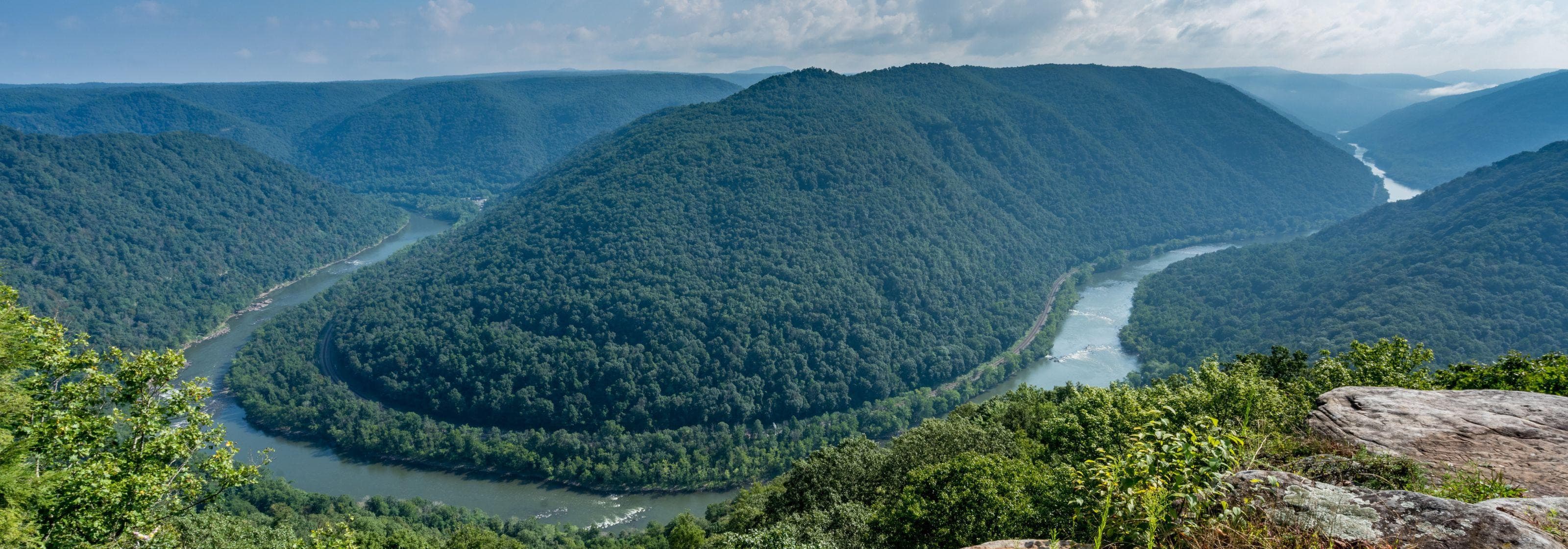
West Virginia’s terrain is beautiful—and expensive to build on.
Site work is where two identical house plans can diverge dramatically, especially when you factor in:
- steep slopes requiring retaining walls
- longer driveways (cut/fill, gravel base, drainage)
- rock excavation
- stormwater management needs
- limited access for concrete trucks or cranes
- bringing in electric service over distance
- well drilling and septic systems (or extensions to public utilities)
A generic “site work allowance” is often the most dangerous number in a budget because it’s the easiest to underestimate before you have a survey, soils info, and a clear driveway/utilities plan.
Rule of thumb (estimates): In West Virginia, site work + utility hookups can be “modest” on a flat lot with existing utilities, or it can become a major line item on rural/hillside lots. Many local cost guides (including city-level summaries) commonly cite ranges like $15,000–$45,000 for site prep and utility hookups as a starting point, but that can be exceeded quickly when excavation, retaining, or long utility runs are involved. (Treat this as a planning range—not a quote.)
Foundation choice: slab vs crawlspace vs basement (and the ripple effects)
Foundation type is a major cost lever, and it’s tightly connected to your site.
Slab-on-grade
Often the lowest-cost foundation approach when the site supports it (good access, manageable grading, proper drainage). Slabs can also reduce framing and HVAC complexity in some designs—but may require more careful planning for plumbing runs and future changes.
Crawlspace
Common in many areas, but costs can rise with:
- tall crawl heights for sloped lots
- moisture control needs (encapsulation, dehumidification)
- more complex perimeter and drainage details
Basement
Basements can be cost-effective per square foot of added usable area, but they can materially increase:
- excavation (especially rock)
- concrete and waterproofing
- drainage systems
- egress requirements if finishing space
- construction timeline risk (weather + water)
Budget reality: A basement is rarely “just a little more.” It’s a scope change that impacts multiple divisions: earthwork, concrete, waterproofing, plumbing, HVAC, electrical, and sometimes structure.
Plan design complexity: the “same size” house that costs 20% more
Square footage alone is a poor predictor. Two 2,000 sq ft homes can have very different costs depending on design decisions like:
- Footprint shape: a simple rectangle is cheaper than lots of corners and jogs (more foundation, more framing labor, more flashing and risk)
- Roof: multiple valleys, dormers, and steep pitches increase framing and roofing labor
- Ceilings: vaulted/great rooms affect structure, insulation, HVAC sizing, and finish labor
- Windows: larger window area and higher counts raise both material and labor, and can require upgraded headers
- Exterior finish mix: combining siding + stone + board-and-batten adds detail labor
- Garage configuration: a side-load garage can add wall complexity and driveway length
- Mechanical distribution: long runs, multiple zones, and finished basements change ductwork and equipment selection
This is exactly why broad averages can mislead: the “average home” is not your plan.
What to include (and not include) when you hear “cost to build”
When someone says “It costs $X to build in West Virginia,” clarify what they’re including.
Typically included in “construction cost”
- foundation
- framing
- roofing
- windows/doors
- rough plumbing/electrical/HVAC
- insulation and drywall
- interior finishes (variable)
- basic landscaping/cleanup (variable)
- general contractor overhead and profit (sometimes shown separately)
Often excluded (or treated as allowances)
- land purchase
- major site work (rock blasting, retaining walls, long driveways)
- well/septic or major utility extensions
- architectural/engineering beyond standard plan set
- financing costs (construction loan fees/interest)
- owner upgrades, change orders, and selections beyond allowances
Key Takeaway: what a realistic 2026 West Virginia budget looks like
A realistic 2026 budget for building a house in West Virginia should start with a local, city-adjusted baseline (for example, RSMeans-based costs showing ~$113/sq ft in Parkersburg, ~$122/sq ft in Morgantown, and ~$125/sq ft in Charleston for standard finish), then immediately adjust for the cost drivers that create the biggest swings:
- finish level (basic vs premium can be a dramatic spread)
- site work (slopes, rock, driveway length, drainage)
- foundation type (slab vs crawl vs basement)
- labor availability and schedule risk by region
- permitting/fees and utility connection requirements by jurisdiction
- plan complexity (rooflines, corners, ceilings, window count)
If you take only one thing from this guide: a “per-square-foot” number is not an estimate—it’s a starting point. Your real cost lives in the line items.
Ready for a line-item estimate that matches your plan and your location?
If you’re serious about budgeting, the next step is seeing costs broken down the way builders and lenders think about them—by trade and by scope.
- Start by exploring a free interactive sample so you can see exactly what a detailed report looks like before you buy: Try a free demo report
- When you’re ready, you can get a customized, plan-specific report (with detailed line items) for $32.95: order your custom Cost To Build report
CostToBuildAHouse.com has been providing cost-to-build reports for nearly 20 years, and the entire point is to replace vague averages with a clear, plan-and-location-specific budget you can actually use.