
In this article
Cost To Build A House In Ohio (2026)
If you’ve searched “cost to build a house in Ohio,” you’ve probably seen a wide range of numbers—sometimes so wide they feel unusable. That’s not because the internet is wrong; it’s because new-home construction costs in Ohio are inherently variable.
In 2026, realistic base construction estimates for Ohio range from roughly $120 to $350+ per square foot, depending on the plan, the site, and the finish level. Many published "Ohio averages" cluster around $140–$170/sf — but those figures often exclude land, sitework surprises, utility runs, and owner-selected upgrades that can move the real number substantially.
The purpose of this guide is not to give you a single number. It’s to show you why the number changes so much—and what you need to price your house plan accurately in your Ohio location.
Free instant estimate · ~30 seconds
Quick Estimator
No sign-upRough planning range based on your inputs and current regional cost indices — not a quote. Your plan, lot, and selections move the number; the full report prices all 60+ items to your exact zip.
✓ Free — no sign-up · ✓ 60+ line items · ✓ ZIP-localized · ✓ Planning figures, not bids
2026 snapshot: what’s pushing Ohio build costs up (and why it’s not uniform)
Even though Ohio is often considered “moderate cost” compared to many coastal markets, build pricing still moves year to year and city to city.
Two 2026 realities matter a lot:
-
Labor remains a major driver. Engineering News-Record’s 1Q 2026 cost report notes that skilled labor rose about 5.7% and common labor about 4% (with broader construction cost indexes rising as well). Those are national trends, but they show why builders keep updating bids.
Source: ENR, “1Q 2026 Cost Report…” (March 24, 2026). -
Local wage structures differ significantly within Ohio. For example, union carpenter wage sheets for Ohio (May 2025–April 2026) show taxable hourly rates around $32–$39/hour in several Northeast Ohio zones, with non-taxable benefit rates commonly in the $23–$26/hour range. That’s a reminder that “labor cost” is not just an hourly wage—it’s wage + burden + availability + scheduling.
Source: Central Midwest Regional Council of Carpenters wage rate sheets (May 2025–April 2026) hosted by AGC Akron.
Those trends don’t translate to a simple “add X dollars” rule. Instead, they reinforce why builders price by scope + labor productivity + risk, not by a statewide average.
A practical 2026 cost range for Ohio (and what it includes)
Most homeowners care about the all-in build price, but online figures are often “base build” only. Here’s a more useful way to think about it.
Typical “construction only” ranges (estimates, 2026)
These ranges are not quotes—just planning-level brackets to illustrate the spread:
- Production/tract-style build (simpler plan, moderate finishes): ~$120–$170/sf
- Typical custom home (more design complexity, mixed finishes): ~$170–$240/sf
- High-end custom (architectural detailing, premium systems/finishes): ~$240–$350+/sf
What usually is included in “construction only” varies by builder, but often covers: foundation, framing, basic MEPs, insulation/drywall, standard interior finishes, roofing, and basic exterior cladding.
What often is not included: land, major sitework surprises, long utility runs, well/septic, permit/impact fees, certain design/engineering costs, landscaping, fencing, driveways beyond a basic allowance, retaining walls, premium appliances, and owner-selected upgrades.
Wondering what these ranges mean for your town? The free calculator above localizes them to your ZIP.
Get my Ohio estimate ↑Ohio city and region differences: why Columbus doesn’t price like rural Ohio
Ohio isn’t one market. Your cost can change notably just by crossing county lines.
Common patterns we see in pricing:
- Columbus metro: often higher due to demand, tighter trade availability, and faster-moving schedules.
- Cleveland/Akron/Canton: pricing can vary widely by neighborhood and site conditions (including older infill lots that require demolition, tricky access, or utility work).
- Cincinnati metro: strong variability driven by hills/topography, foundation needs, and neighborhood-by-neighborhood expectations (finishes and exterior materials).
- Dayton/Toledo/Youngstown and many rural areas: sometimes lower labor competition, but costs can rise if you’re far from suppliers or if there’s a smaller subcontractor pool.
Permit fees example (real 2026 data)
Permits are a great example of how “soft costs” differ by city. In Columbus, the 2026 fee schedule lists:
- New 1-, 2-, or 3-family dwelling building permit (includes 6 inspections): $1,100
- Mechanical/Electrical/Plumbing permit (includes 2 inspections): $275
- Deck permit (includes 3 inspections): $350 (if applicable)
Source: City of Columbus, “2026 Combined Development Related Fee Schedule” (effective Jan. 22, 2026).
That’s one city. Other Ohio jurisdictions use valuation-based schedules or different fee bundles, so permit totals for the “same house” can move a lot.
Where the money goes: a realistic cost breakdown (why line items matter)
Two homes can both be “2,400 square feet” and still be $150,000 apart. The biggest reason: the price is made of dozens of line items that change with plan geometry and site conditions.
Here’s a simplified view of major buckets that commonly swing budgets (estimates shown as share-of-total for many builds):
- Sitework & utilities: 5%–20%+
- Foundation: 8%–15%
- Framing & structural: 15%–25%
- Exterior envelope (roofing, siding, windows/doors): 15%–25%
- MEP (plumbing/electrical/HVAC): 15%–25%
- Interior finishes (drywall, trim, cabinets, flooring, tile, paint): 20%–35%
- Builder overhead & profit + contingency: varies widely
The “right” breakdown for you depends on your plan (and what you count as part of construction versus owner costs). This is why detailed, line-item estimates are so valuable: they prevent you from budgeting 10% for sitework when your lot needs 20%.
The biggest cost drivers in Ohio (and how they change the number fast)
1) The house plan: complexity is expensive, even at the same square footage
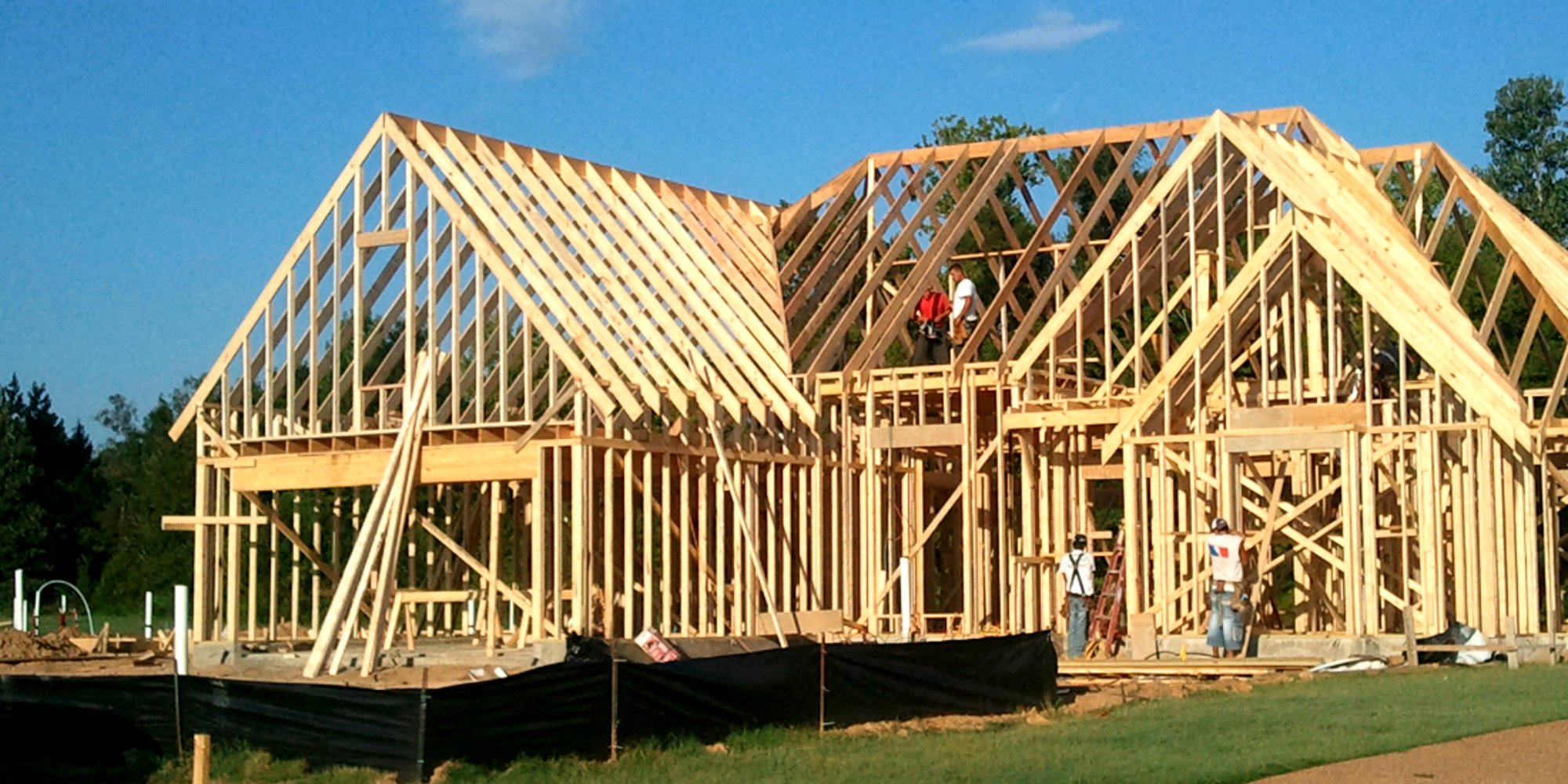
A compact rectangle is usually cheaper per square foot than a house with:
- Multiple bump-outs and corners
- Complex rooflines (valleys, dormers, multiple pitches)
- Tall great rooms and stair-heavy layouts
- Large spans requiring engineered beams
- Lots of window area or oversized openings
Two plans at 2,200 sf can use very different amounts of concrete, framing lumber, and labor hours.
2) Foundation choice and soil/topography
Ohio has everything from flat suburban lots to hillside sites and clay-heavy soils. Foundation type can swing costs dramatically:
- Slab-on-grade: often lowest cost (but depends on frost protection, insulation requirements, and grading)
- Crawl space: mid-range (venting/conditioning approach matters)
- Full basement: higher concrete and waterproofing costs—but common in Ohio and sometimes preferred for resale and storage
Add conditions like high water tables, rock, steep slopes, or the need for retaining walls and costs can jump quickly.

3) Mechanical systems and energy requirements
“HVAC” is not one number. It’s equipment sizing, duct design, zone controls, ventilation strategy, and installation labor. In 2026, homeowners also increasingly choose:
- Heat pumps (sometimes dual-fuel)
- Higher-efficiency furnaces/AC
- Better filtration/IAQ upgrades
- Tankless water heaters or hybrid electric tanks
Those choices change not only the equipment cost but also electrical requirements, ducting complexity, and sometimes insulation/air-sealing scope.
4) Finish level: the silent budget killer
Finishes are where online averages break down.
Examples of common upgrade triggers:
- Custom cabinets vs. stock
- Quartz vs. laminate countertops
- Tile showers with niches and glass enclosures vs. fiberglass surrounds
- Real hardwood vs. LVP vs. carpet
- Premium windows/doors (and black window packages often cost more)
- Exterior upgrades (stone veneer, fiber cement, architectural details)
Finish decisions can easily move a typical Ohio build by $30–$80/sf depending on scope.
5) Labor availability and scheduling risk
Labor isn’t just the hourly rate—it’s whether trades are available when needed, and whether delays create cascading costs.
The 2025–2026 carpenter wage sheet example shows how wages and benefits can be substantial in certain Ohio regions. Meanwhile, ENR’s 2026 report highlights continued labor increases. When subs are booked out, builders price risk into bids: rush scheduling, overtime, or longer timelines.
Sources:
- ENR 1Q 2026 Cost Report (labor increases).
- Central Midwest Regional Council of Carpenters wage rate sheets (Ohio zones).
6) Site access, utilities, and “hidden” prep costs
This is where many budgets blow up because the costs don’t show on a pretty floor plan:
- Clearing trees, demolition, hauling, and erosion control
- Long driveway runs or culverts
- Extending water/sewer or installing well/septic
- Rock excavation or undercut/fill for poor soil
- Temporary power, jobsite logistics, and winter conditions
A rural build can look cheaper per square foot—until the utility and driveway line items are added.
Example budgets: why two Ohio “2,000 sf” builds don’t match
These simplified scenarios show how the same size can create very different totals (construction only, excluding land; estimates):
Scenario A: 2,000 sf ranch, slab, moderate finishes, easy suburban lot
- $140–$185/sf → $280,000–$370,000
Scenario B: 2,000 sf two-story, basement, more corners/roof complexity, upgraded finishes
- $190–$260/sf → $380,000–$520,000
Scenario C: 2,000 sf custom, hillside lot, retaining walls, premium windows and tile-heavy interiors
- $260–$350+/sf → $520,000–$700,000+
If you’ve been trying to reconcile a single “Ohio average,” this is why it doesn’t work. The plan and the lot are doing most of the math.
Don’t forget these Ohio “soft costs” that aren’t in most online estimates
Even if you have a builder quote, homeowners often underestimate the add-ons that sit outside the contractor’s base scope:
- Plan drafting changes, engineering, trusses, or structural redesign
- Survey, soil test, and site engineering
- Permits, inspections, and possible zoning/variance fees
- Temporary housing, storage, and financing carry costs if the build runs long
- Landscaping, fencing, driveway upgrades, patios, and decks
- Allowance overruns (cabinets, tile, lighting, appliances)
As one concrete example, the City of Columbus lists a $1,100 building permit fee for new 1–3 family dwellings (plus separate MEP permits, etc.). Other cities will differ, but it illustrates that permitting is a real, budgetable line item—not a rounding error.
Source: City of Columbus 2026 fee schedule.
Key Takeaway
Ohio home construction costs in 2026 are best understood as a range built from hundreds of line items, not a statewide average. Labor trends, material volatility, plan complexity, foundation choice, site conditions, and local permitting all interact—so two similar-looking homes can land tens (or hundreds) of thousands apart.
If you want a budget you can actually plan around, you need a detailed estimate tied to your exact house plan in your exact Ohio location, with real quantities and local assumptions.
Next step: get your Ohio cost estimate
If you’re serious about building in Ohio, the fastest way to understand your likely cost is to look at a line-item Cost To Build report—the kind that breaks the project into the real categories builders price (sitework, foundation, framing, MEP, finishes, overhead, and more).
CostToBuildAHouse.com has been providing cost-to-build reports for nearly 20 years, and the goal is simple: help you see where the money goes for your plan—before you commit to bids, loans, or design changes.
- First, Try a free demo report to explore what the report looks like and how the line items are organized.
- Then, when you’re ready, you can order your custom Cost To Build report for your specific house plan for just $32.95.
That way you’re not guessing from an “Ohio average”—you’re budgeting from a plan-based estimate built for your project.